Practical guide 4 min read
A publisher can look impressive in a sales sheet and still be a poor fit for your audience. Before you approve a link-building placement, check whether its readers, editorial content, link terms and total cost make sense for the page you want people to visit. This checklist helps you ask the same questions of every proposed site instead of deciding from one authority score.
It is a buyer’s evaluation tool, not a promise that a backlink will improve rankings. If you need the sourcing, outreach and placement workflow, see our Link Building service. The broader SEO service covers technical, on-page and content work alongside off-page decisions.
1. Write down the destination before evaluating a publisher
Record the exact landing-page URL, the topic or keyword you want to support, the intended audience and the market or language. Ask whether the destination answers that audience’s question today. A placement pointing to a thin or mismatched page is unlikely to produce useful referral visits, however strong the publisher appears. If you do not yet have a suitable page or keyword map, plan that work separately before commissioning outreach.
2. Check topical and audience fit
Open recent articles, not just the homepage. Are the subjects genuinely related to your product, service or useful guide? Is the publication written for the country, language and professional audience you want to reach? A software-development article on a technology publication may be more useful than a generic “high-metric” site with unrelated posts. Ask where your contribution would appear and whether a real reader could reasonably follow its contextual link.
3. Review editorial standards and visibility
Look for named or accountable authors, a consistent topic, clear editing, original reporting or practical examples, working navigation and recent publication activity. Review organic visibility and referring-domain trends as screening signals, not guarantees. Third-party authority scores are estimates; no single score proves that a site has engaged readers or that its links will help your search performance. Be cautious of sites with abrupt topic changes, many unrelated sponsored posts, copied content, or an obvious catalogue of paid links.
4. Get the exact link and payment terms in writing
Ask for the full publisher charge, what is included, the proposed page section, editorial requirements, turnaround, whether the placement is permanent or time-limited, and who pays the publisher. Confirm the destination URL, likely anchor context, disclosure and link attribute. A price quote without these details is not a complete proposal. Keep any agency sourcing or content fee separate from the publisher’s charge so the total cost is transparent.
Google’s link-qualification guidance says paid placements should use rel="sponsored"; rel="nofollow" is also acceptable. A genuinely editorial link needs no special rel attribute, but it is the publisher’s editorial choice. Google’s spam policy identifies buying links for ranking manipulation and paid links that pass ranking credit as link spam. Do not treat a paid, unqualified “dofollow” promise as a safe shortcut.
5. Keep a one-row decision record for every proposed site
| Field to record | Decision question |
|---|---|
| Publisher and proposed section | Does this section normally serve the intended topic and reader? |
| Market and language | Will the audience understand and use the destination page? |
| Recent editorial examples | Are at least a few current articles original, useful and relevant? |
| Visibility and link profile | Do the trends raise quality questions that need explanation? |
| Content and link terms | Who approves the article, disclosure, URL, context and rel value? |
| All-in cost and payment timing | Are publisher and service charges separated and approved? |
| Publication and follow-up | Who supplies the live URL and checks the link after publication? |
Use a simple outcome for each proposal: approve, ask for evidence or decline. Do not convert a weak match into an approval just because a metric is high. For an international campaign, apply this record separately by market; a site useful for the UK may not serve an Australian or UAE audience. Our International Services hub explains how market-specific content and delivery connect.
6. Verify what actually went live
After publication, open the live article and confirm that it is accessible, relevant, correctly attributes the destination, and links to the agreed URL with the agreed rel value and disclosure. Record the publication date, URL and any agreed review period. Recheck the link during that period: pages can be edited, removed or redirected. Monitor referral visits and enquiries where measurement is available, but do not attribute a ranking change to one placement without broader evidence.
When to decline a proposal
- The publisher will not show a real site or proposed section before payment.
- The topic and audience are unrelated to your landing page.
- The sales pitch guarantees rankings or a paid “dofollow” link that passes ranking credit.
- Publisher fees, disclosure, link terms or payment timing remain unclear.
- The site appears built mainly to sell links rather than serve readers.
If you already know your keyword, landing page, market and preferred publisher criteria, send a brief for publisher research. Agal’s published service fee and the separate publisher-payment model are explained on the service page; optional keyword research or landing-page planning is quoted separately before that extra work starts. Agencies needing delivery under their own brand can review our White Label services.
WEBSITE PACKAGES
Choose the build that fits your business now
Clear starting scope. Extra work is priced before we begin.₹4,999 + GST
Up to 10 pagesDevelopment-time on-page SEO · extra content pages ₹300 each
Request a detailed quote →₹9,999 + GST
Up to 25 pagesSEO-ready structure · extra content pages ₹300 each
Request a detailed quote →₹9,999 + GST
Up to 50 ready-content product uploadsDomain and hosting separate · custom content quoted separately
Request a detailed quote →₹4,999 + GST
Up to 20 ready-content product uploads50 / 100 / 150 product packages available · subscription separate
Request a detailed quote →Visiting Card Website
Your business card, ready to share anywhere
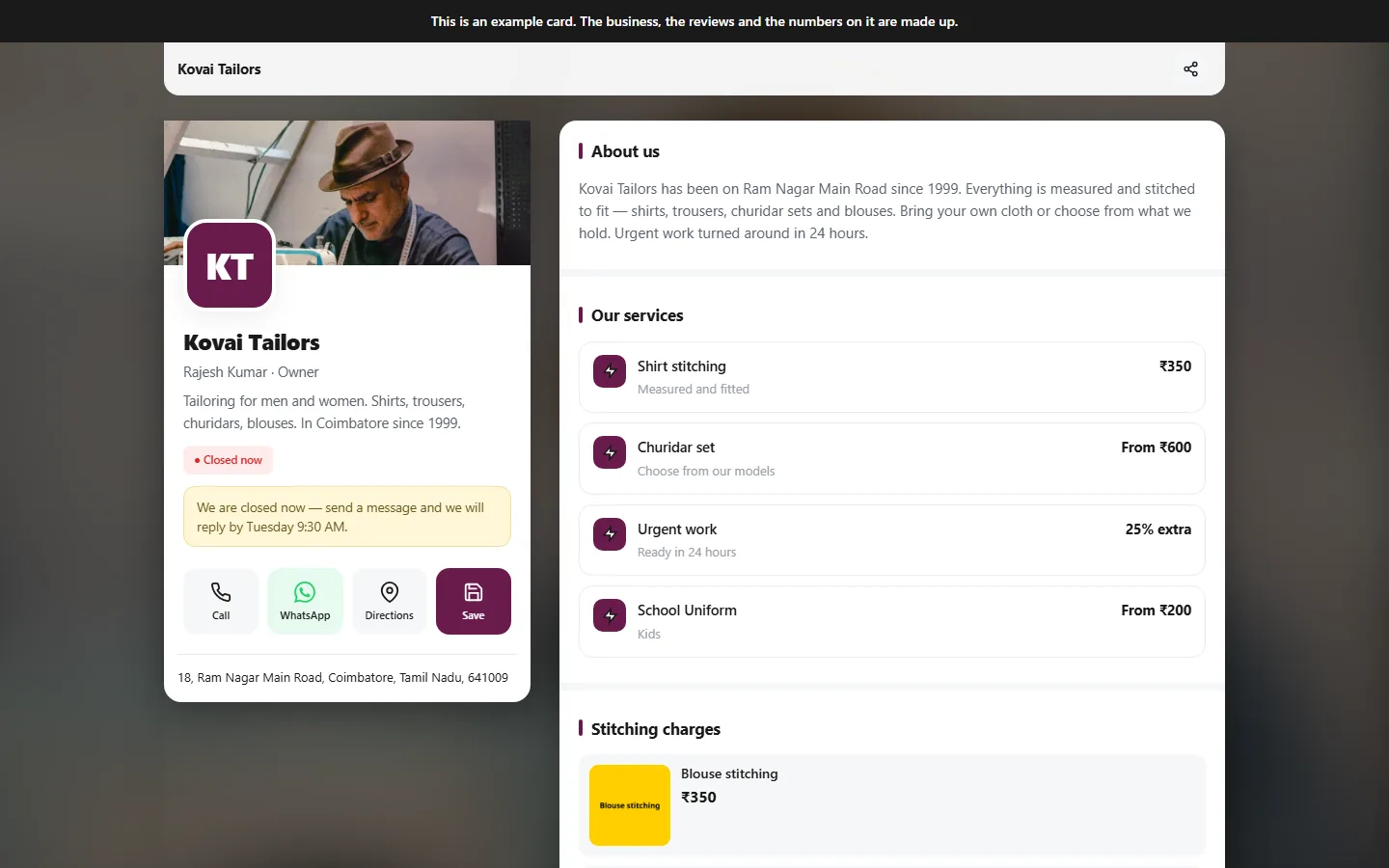
A complete mobile-friendly business website that customers can open, save and share from any device.
- Mobile editing with automatic saving
- Call, WhatsApp, directions and save contact
- Services, products, prices, gallery and opening hours
- Enquiries, quotations, bookings and business tools
- Google reviews, SEO checks and visitor analytics
- Own domain, hosting, SSL and two business emails
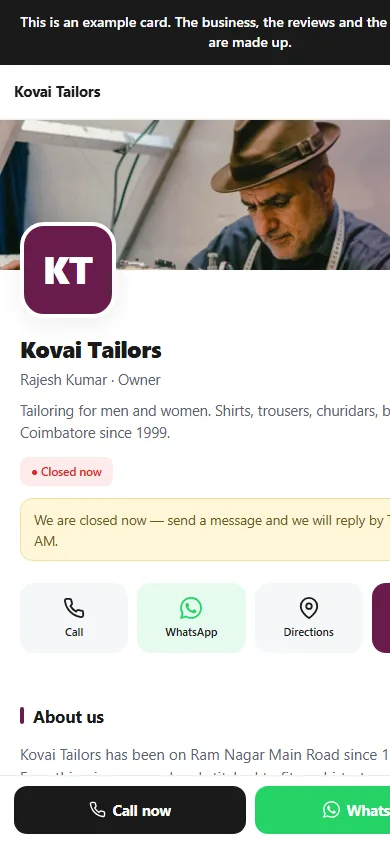
Responsive on every screenDesktop · tablet · mobile
Related Blogs